
Tolkien in Dorset
J.R.R. TOLKIENLYME REGISBOURNEMOUTHPOOLE
6/2/20267 min read
Source: Flickr (full attribution below)
It’s well documented that J.R.R. Tolkien’s fascination with the landscape and lore of his ancestral home, the West Midlands, was a large part of the inspiration for his world of Middle Earth, but did you know that he also had a lifelong, if not as strong, connection to Dorset and the Wessex area? In fact, to use a bad pun, one might say that Dorset bookended his life.
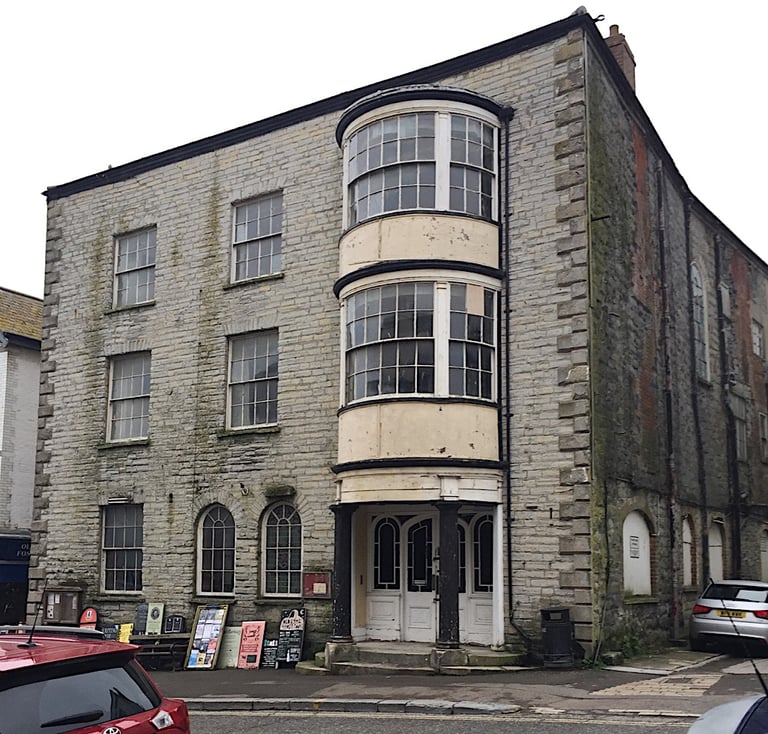
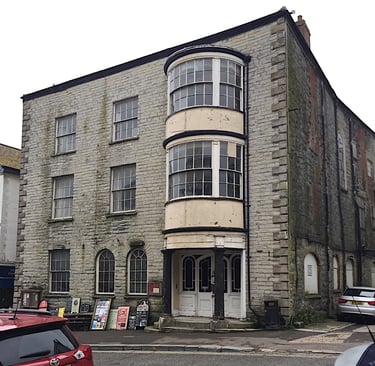
It may not look like much today, but the Three Cups Hotel was the site of happy childhood holidays for Tolkien. Source: Wikimedia Commons
Childhood
Tolkien came to know Dorset as a boy. After he and his brother Hilary were tragically orphaned at their mother’s death in 1904, when Ronald (the middle name he went by) was only twelve and Hilary was ten, they were left under the guardianship of Father Francis Morgan, a Catholic priest (though they lived with their Aunt Beatrice). Father Morgan was by all accounts a kind and caring guardian and tried to give the brothers a decent childhood, which included summer holidays to Lyme Regis, where they stayed at the Three Cups Hotel. The young Ronald enjoyed exploring and sketching the scenery. Once, investigating a recent landslip, he discovered a prehistoric jawbone, which he took to be a piece of petrified dragon (Carpenter, pp. 45-46). Fossil hunting and the Jurassic coast undoubtedly fanned the flames of the young Tolkien’s fascination with dragonology.
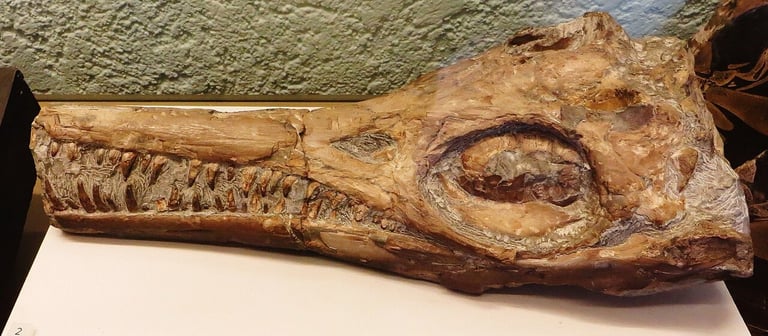
It's hard not to believe this ichthyosaurus is a dragon. Source: Wikimedia Commons
And... I haven't yet verified if this was the same year that he found the jawbone, but in 1908, when Tolkien was still taking holidays in Lyme Regis, there was a huge landslip, resulting in the ignition of all the debris - shale, iron pyrites and cement stones, sending out smoke and flames and making people think a volcano was erupting. Consider the photograph below. Can you say Mordor?
(On a side note, apparently, it was during discussions with the boys that Father Francis learned they were not so happy lodging with their childless aunt, and moved them to a new home where Edith Bratt, also an orphan, was lodging, thus launching a love story that literally – and literarily – became a legend (Carpenter, p. 46).)
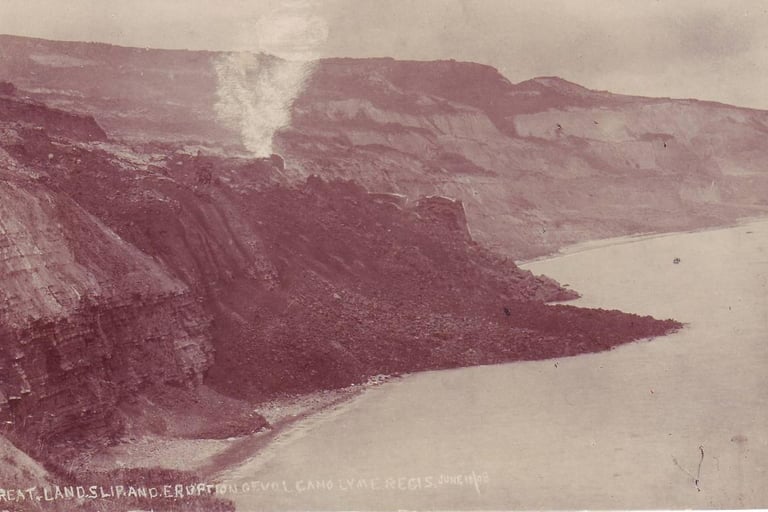
Source: via Dorset Echo. Postcard is in public domain.
Parenthood
Tolkien must have had fond memories of these holidays in Lyme Regis with his guardian as he later returned with his own family, often joined by Father Francis (Carpenter p. 163). Although he was firmly established in his academic and writing career by now, he remained a lifelong artist; during these holidays, he drew several pictures either of Lyme Regis or fantasy scenes which have elements of the Dorset/Lyme landscape in them, including illustrations for The Silmarillion (Carpenter, p. 166).
His children’s story Roverandom, although originating as a tale Tolkien told his children on a Yorkshire holiday when his son lost a favourite toy dog, was written down and partly illustrated while the family was holidaying in Lyme Regis (Collected Poems, p. 712). Sadly, his publisher didn’t see fit to print it until the 1990s. I’d love to say Tolkien began writing The Lord of The Rings in Dorset, but apparently that honour goes just over the border to Devon. Tolkien worked on his masterpiece in Sidmouth, while his children played in rock pools. (I’m still playing in rock pools, which is perhaps why I haven’t written a 1,000-page trilogy and invented a new genre.)
It is speculated that Maiden Castle may have been an inspiration for the barrows in The Lord of the Rings, though Tolkien’s children recall being taken to visit other famous Neolithic sites such as Wayland’s Smithy (Carpenter, p. 163). Still, the Dorset landscape is littered with barrows, and surely reinforced the ideas that developed into the Barrow Wights episode of The Lord of the Rings (no, that wasn’t in the movie).
Dorset, with its unspoilt coast, was at least not the inspiration for Tolkien’s comic/absurd poems of the 1920s set in the fictional Bimble Bay, where he laments the influence of tourism on seaside towns, their generic high street shops with postcards of 'Godknowswhere’ and litter strewn ‘on grass and shore’ (‘Bimble Town, or Progress by the Sea’ in Collected Poems, pp. 716-717). Sadly, I don’t know if he would feel the same today about some of the popular towns along the Dorset coast.
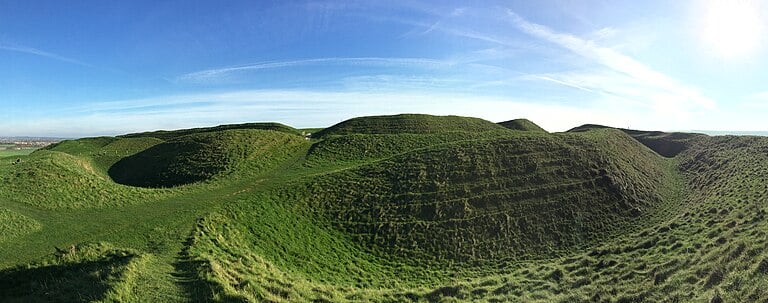
Maiden Castle, Dorset. Source: Wikimedia Commons
Retirement
In the later years of their marriage, from the early 1950s, Edith had begun to take holidays by herself at the Hotel Miramar in Bournemouth. The milder sea climate was better for Edith’s health – she suffered from arthritis – and gave her a break from the increasingly physical difficulty of keeping house. She is also known not to have enjoyed academia, but found a social circle more to her taste down on the coast. Although the life of a coastal retiree did not entirely suit him, Tolkien was happy to accommodate Edith after all the years she had spent supporting him. They also soon made friends with Doctor Denis Tolhurst and his wife Jocelyn, who could oversee their health and (in the case of Jocelyn) offer Tolkien secretarial services (Carpenter, p. 251). The Tolkiens engaged two rooms so that Tolkien could continue to write, while Edith enjoyed her own friends and pursuits (Carpenter, pp. 248-249).
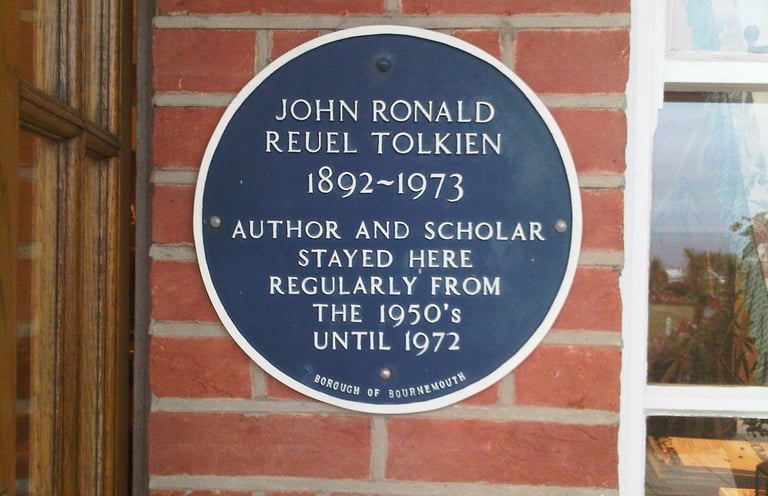
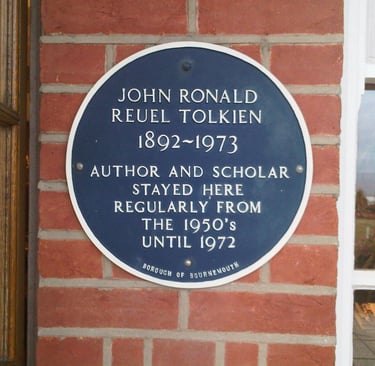
In fact, during this time, Tolkien was working on many projects (he was a hopeless, perfectionist non-finisher), such as The Adventures of Tom Bombadil, ‘Leaf by Niggle’, and Smith of Wootton Major; manuscripts of at least two of his poems exist in forms on Hotel Miramar stationery: ‘The Mewlips’ and ‘The Complaint of Mim the Dwarf’ (Collected Poems, p. 674) (Mim is a character in The Silmarillion). It was at the Hotel Miramar that Tolkien apparently signed the deal for the film rights to The Lord of the Rings with United Artists in 1969, for 100,000 dollars. Today, a blue plaque commemorates his time there.
Apparently, Tolkien became increasingly burdened with his fame in the later 1960s, frequently interrupted in his Oxford home by hippies and callers from America who had no regard for the time difference. This, and his wife’s ill health, prompted a permanent retirement down to Branksome Park, Poole, to a bungalow they named Woodridings at 19 Lakeside Road, with a modern kitchen and central heating, and crucially, no stairs, to help Edith. Their home backed onto Branksome Chine and they were close to the sea and of course Doctor and Mrs Tolhurst. It was during these years, 1968–71, that Tolkien tried to work seriously on finishing The Silmarillion, with the help of his publisher’s secretary who travelled down to work for him.
I don’t want to make over much of the Dorset influences on Tolkien as he completed works in the county. After all, I sit at my desk in Slovenia totally immersed in 1950s Dorset; I can certainly see that Tolkien might be deep in Middle Earth, completely oblivious of his surroundings. He was undoubtedly more isolated - while Edith was more in her element, a reversal of much of their married life - and missed his Oxford circle, particularly the Inklings (C.S. Lewis had died in 1963). However, I’d like to think that Dorset, a place so steeped in early English history, and its ancient landscape, at least bolstered his spirits as he worked.
After Edith’s death in November 1971, Tolkien returned to his familiar academic sphere of Oxford, but he continued to visit his new friends in Bournemouth. In August 1973, he travelled down to stay with the Tolhursts. It was here that he became ill with a gastric ulcer, contracting a chest infection in hospital and dying in September 1973 at the age of eighty-one. Only two of his children, John and Priscilla, were in the UK at the time, but both managed to make it to his bedside (Carpenter, p, 257). The bungalow was eventually demolished in 2008 and pieces/artefacts auctioned off. The developers built two luxury ‘eco villas’ they named Beren and Luthien House, respectively. Perhaps, with this in mind, it is just as well that Tolkien left Dorset and did not pass away in Woodridings.
By the way, I have some of Tolkien’s stymying perfectionism, and this is just my first attempt at exploring his connections to Dorset. Expect updates as I dig deeper!
Notes
1. Maybe Wessex would technically be a better description for this piece, but I took a small liberty. To be precise, before the country administrative areas were redrawn shortly after Tolkien’s death, Poole was its own county (under a charter first given by Elizabeth I); Bournemouth was part of Hampshire. However, both are considered to be within the ceremonial county of Dorset.
2. Tolkien’s estate is, thankfully, carefully managed, and all his writings, artwork, photos of him etc. are under copyright, so sadly I could not share first-hand images. (Although it was okay for them to let Peter Jackson ruin The Hobbit and to sell out to Amazon. But I digress.) Quotes from his poetry have been selected and used, according to my best understanding, within the guidelines of Fair Use/Fair Dealing (US/UK).
3. The Three Cups Hotel was bought and left derelict for many years by Palmers Brewery. Currently, plans are afoot for a sensitive redevelopment that saves this hotel that has been host to many famous names besides Tolkien’s. https://www.bridportnews.co.uk/news/25140861.former-lyme-regis-three-cups-hotel-demolished/
Sources
Humphrey Carpenter, J.R.R. Tolkien: A Biography. A lot of online sources have random facts about Tolkien's time in Dorset, but the information is gathered in one place in this early definitive biography. Page numbers refer to my HarperCollins 2020 edition.
The Collected Poems of J.R.R. Tolkien (3 volumes, ed. Christina Scull and Wayne G. Hammond, HarperCollins, 2024)
Some specific notes on Tolkien's time in Lyme Regis can be found at: https://www.lymeregismuseum.co.uk/lrm/wp-content/uploads/2021/08/jrr_tolkien_article.pdf
A modern news report on the 1908 landslide can be found at https://www.dorsetecho.co.uk/news/features/lookingback/18489604.lyme-regis-hit-volcano-june-1908/