
A Dorset Parish Christmas 1949-53
CHRISTMASREVEREND OLIVER WILLMOTTDORSET CHURCHESDORSET 1950S
12/5/20255 min read
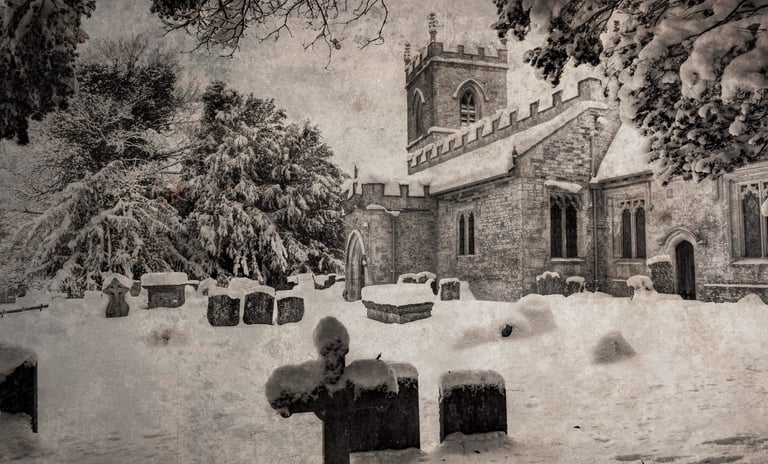
Reverend Oliver Willmott served as priest for three Dorset parishes (Loders, Dottery and Askerwell) for over thirty years. During his tenure, he faithfully wrote a monthly parish newsletter that began with a modest circulation, eventually to be sent around the world to those eager for news of back home. I’m eternally grateful to both Reverend Willmott and his family, who published three volumes of his writings after his death, for giving me exactly the information I need for the character of the Reverend Stephen West in the 1950s cosy mystery series I’m currently writing.
Reverend Willmott comments in 1950 that ‘one needs to be in a village to get the old spirit of Christmas’ (Yours Reverently, p. 6). This was certainly true of his parishes. In the mid-twentieth century, Dorset (and neighbouring Devon) were still counties dominated by local landowners and living the traditional estate way of life that had fallen to the hammer of death duties in so much else of England. The vicar himself was very much a country parson, living in his main parish of Loders on a smallholding that helped support his family of seven children and walking miles between his parishes on a Sunday to tend to his scattered flock.
The local squire was Sir Edward Le Breton, who resided at Loders Court. Sir Edward and Lady Breton took their duties very seriously, opening their purse and their home to the people of Loders throughout the year, and setting the example of attending church. At Christmas 1949, Willmott tells us ‘The Squire’s party filled the chancel stalls, and a very representative congregation filled the church’ (p. 6). The Le Bretons provided Christmas trees for the church (hung with ‘fairy lamps’) and the village school and elsewhere with such generosity that in 1951, the vicar had to put out a plea: ‘Sir Edward’s estate has been so drawn on for Christmas trees that there are no more available. Has anybody any suggestions to offer, or better still, a tree?’ (p. 113).
Christmas carolling was a competitive sport between local choirs, as evidenced by the vicar’s listing of their takings compared to others’ in the area. The choir were out faithfully and cheerfully each Christmas in all weathers, raising money for the Church’s Children’s Society. They roamed far and wide, stopping at the ‘big houses’ such as Upton Manor and Loders Court (of course) and anywhere that would give them refreshments – the vicar remarks of 1948 jollifications that ‘they lingered so long over refreshment provided at Matravers and Upton Manor that by the time they had worked back to Shatcombe the audience were mostly in bed’ (p. 4). The several nights of carol singing were traditionally rounded off with ‘with a feast and ghost stories at the big fireplace of the vicarage' (p. 6). The vicar obviously enjoyed his annual ghost story renditions, though he remarks in 1951, ‘The vicar’s vampire story put some of the company to sleep. Or was it the mince pies?’ (p. 37).
Children, of course, were central to the parish, and at the heart of the Christmas celebrations. The vicar comments quite rightly that the children of Loders had very happy Christmases. At the beginning of December they got a ‘free tea’ at their sale of crafts to raise money for the Missionary Society. At the end of the school term they were treated to a party. They gathered in the school room around the tree donated by the Le Bretons, who also provided a Punch and Judy show, followed by a large tea and presents from Father Christmas. The vicar adds, ‘Even the County Council joined in the conspiracy to give the children a good time. The school meals department sent, at the end of term, an iced Christmas cake, and Christmas puddings with sixpences in them. This was on the rates, of course, but it is likely to be one of the few items of County Council expenditure which nobody will begrudge’ (p. 189). Nor were other parishes neglected. At Askerwell, the schoolchildren were entertained with games, ice cream and then ‘a prodigious tea’ (p. 196). The Junior choir of Loders had the added excitement of being taken to the pantomime in Weymouth and, of course, treated to tea.
On Christmas Day itself, the Mother’s Union provided packets of sweets for all the children who attended church. Reverend Willmott comments, ‘when the children had sung carols round the Christmas tree, on the chancel step, they received packets of sweets from the tree, which they stoically refrained from eating until after the service’ (p. 6). As a father of seven, he surely knew just how restrained they had to be.
Nor was this the end of the excitement for the village children. On the last Saturday of the year, Sir Edward and Lady Breton opened their home for a party, providing transport there and back so that all the parish children could attend. After entertainments by a conjuror, the children sat down to ‘tables laden with sugared doughnuts, cream buns, iced buns, and pyramids of pink and white meringues’ (p.11). The vicar tells us ‘freedom from parental oversight, and the connivance of host and hostess, enabled them to get to grip right away [with the sweets] without the preliminary skirmish with bread and butter’ (p. 19). On their way out to the waiting bus, Father Christmas appeared ‘and bestowed on each guest an orange, chocolate biscuits, crackers, and a half crown’ (two shillings and sixpence, thirty old pence) (p. 11).
And at the heart of all this, for Reverend Willmott and so many of his parishioners, were the church services. Christmas began with Midnight Mass, with the church lit only by two candles on the altar, the lights on the tree, and a lamp in the crib (p. 68). On Christmas Day, the morning service brought not only the residents of the parishes, but those returning home to families, sometimes from overseas. In his Parish Notes, the vicar gave thanks for his filling pews. Looking back on 1951, he tells us how the number of Christmas communicants had doubled in size in the last ten years, to 110, and the collection more than doubled – to twenty pounds. ‘The congregation at the midnight service was the biggest ever, and at matins on Christmas Day the church was packed really tight’ (p. 36). His reflection on this is a fitting ending to this post, and as relevant today as then:
‘To those that have eyes to see, two world wars in half a century shew [sic] that modern man may have conquered the elements, but cannot conquer the evil in himself. Experience is also proving that the delightsome things of man’s invention are a bad substitute for God in trying to satisfy the heart’s deep longings’ (p. 36).
By the way, if you’ve read A Dorset Lammas, you may enjoy the free short-story wrap-up to Ros’s story, ‘A Dorset Christmas’, set several years after the novel (scroll down the page for the story).
Note: For this post, I took extracts from the first volume of Willmott’s Parish Notes: Yours Reverently... from the pulpit, the pub and the Parish Notes 1948-53, written by Rev. O.M. Willmott, edited by Michael Willmott (Bishop Street Press, 1997).
Photo credit: Wikimedia Commons


Photo credit: Wikimedia Commons


Photo credit: Wikimedia Commons